3DPS logo
3DPS Europe
Service and development
News

News / article

Research
← Back to news Back to homepage
Fraunhofer Shape Dithering: reducing staircase artifacts without new hardware
2026. 11. 16.
75

Fraunhofer Shape Dithering: reducing staircase artifacts without new hardware

2 min read

Fraunhofer IGD has presented Shape Dithering, a geometry-processing method intended to reduce staircase artifacts in voxel-based 3D printing.

Fraunhofer IGD has presented Shape Dithering, a geometry-processing method intended to reduce staircase artifacts in voxel-based 3D printing.

Where staircase artifacts come from

3D printers represent continuous three-dimensional shapes using layers or voxels with finite resolution. Sloped and curved surfaces can therefore develop visible staircase or quantization artifacts that require post-processing. The effect differs between technologies, but geometry discretization is important in many workflows.

According to Fraunhofer IGD’s November 12 release, Shape Dithering redistributes quantization errors in the digital representation of geometry. The institute describes it as a parameter-free, purely geometric method. That matters because reducing the visible artifact does not necessarily require a redesigned toolhead or new motion mechanics; the intervention takes place in the preparation software.

Not the same as sanding a finished part

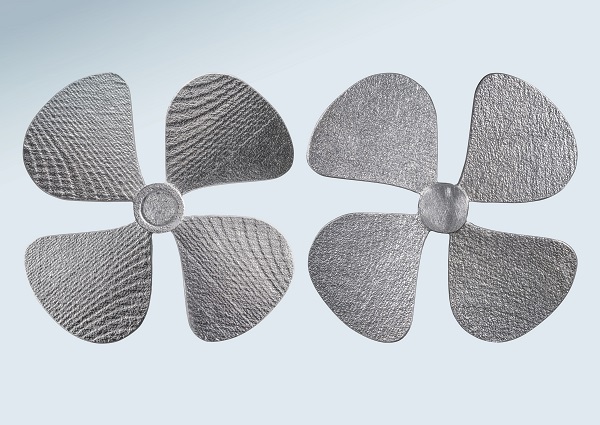
The method acts on the computational shape before printing. Demonstration images compare propeller surfaces and show reduced stair-stepping relative to conventional voxelization. However, they do not prove identical improvements for every machine or material. Dimensional accuracy, strength and manufacturing time still need testing for each process.

At Formnext 2026, Fraunhofer also plans to show unit-cell design and optimization methods as well as RISTRA-AM distortion simulation. The institute says its GPU-based approach can accelerate selected calculations by one or two orders of magnitude compared with established CPU methods.

Why 3DPS is watching

Software-level geometry processing is another path to better part quality without relying solely on expensive mechanics or smaller layers. Next, the underlying measurement methods and compatibility with different manufacturing processes should be examined. Shape Dithering was not presented as a universal one-click FDM slicer feature.

Sources and further information

Original manufacturer source image (Fraunhofer IGD / IGCV): https://www.igd.fraunhofer.de/en/media-center/news-from-the-institute/2026/reducing-staircase-artifacts-in-3d-printing/jcr:content/fixedContent/pressArticleParsys/textwithinlinedimage/imageComponent1/image.img.jpg/1794467514794/FormNext-Shape-dithering-propeller.jpg
Related articles
Archive

Earlier news

109 earlier article(s)
CXMT RAM: China Closes the Memory Gap from DDR5 to LPDDR6
Technology
1 987

CXMT RAM: China Closes the Memory Gap from DDR5 to LPDDR6

China’s ChangXin Memory Technologies (CXMT) is becoming a serious DRAM competitor: its DDR5 memory is appearing in desktop and server systems, while in September 2026 the company also announced mass production of LPDDR6.

2026. 09. 10.
Read
KPI features have been added.
Technology
1 912

KPI features have been added.

KPI features have been added. CALIBRA – Measurem Why do KPIs matter in measurement equipment management? Because data becomes truly useful only when it helps you see where attention is needed and how performance changes over time.

2026. 08. 24.
Read
CALIBRA – A Free Measurement Equipment Management System Is Under Development
Technology
1 759

CALIBRA – A Free Measurement Equipment Management System Is Under Development

CALIBRA – A Free Measurement Equipment Management System Is Under Development A new in-house developed web application is joining the growing collection of 3DPS projects. CALIBRA is being developed as a modern, transparent and expandable measurement equipment and calibration management system. Development has progressed rapidly from the original concept to an already functioning web application, with the foundations of company management, equipment tracking, external partner management and auditing now in place.

2026. 08. 11.
Read
Parkside Multi Charger: Controller Architecture for the Basic and Pro Versions
Technology
1 865

Parkside Multi Charger: Controller Architecture for the Basic and Pro Versions

Parkside Multi Charger: Controller Architecture for the Basic and Pro Versions Development of the Parkside Multi Charger has entered a new stage. During the latest planning phase, several controller and power-switching architectures were compared to find a solution that keeps the Basic version easy to build while leaving enough room for the more advanced Pro model.

2026. 08. 04.
Read
Parkside Multi Charger – New Development Milestone
Technology
1 632

Parkside Multi Charger – New Development Milestone

Parkside Multi Charger – New Development Milestone Development of the Parkside Multi Charger continues to make steady progress. Recent work has focused not only on hardware and software development but also on establishing the project's public identity and communication. The project currently consists of two separate development branches: Parkside Multi Charger (Normal) and Parkside Multi Charger Pro.

2026. 08. 02.
Read
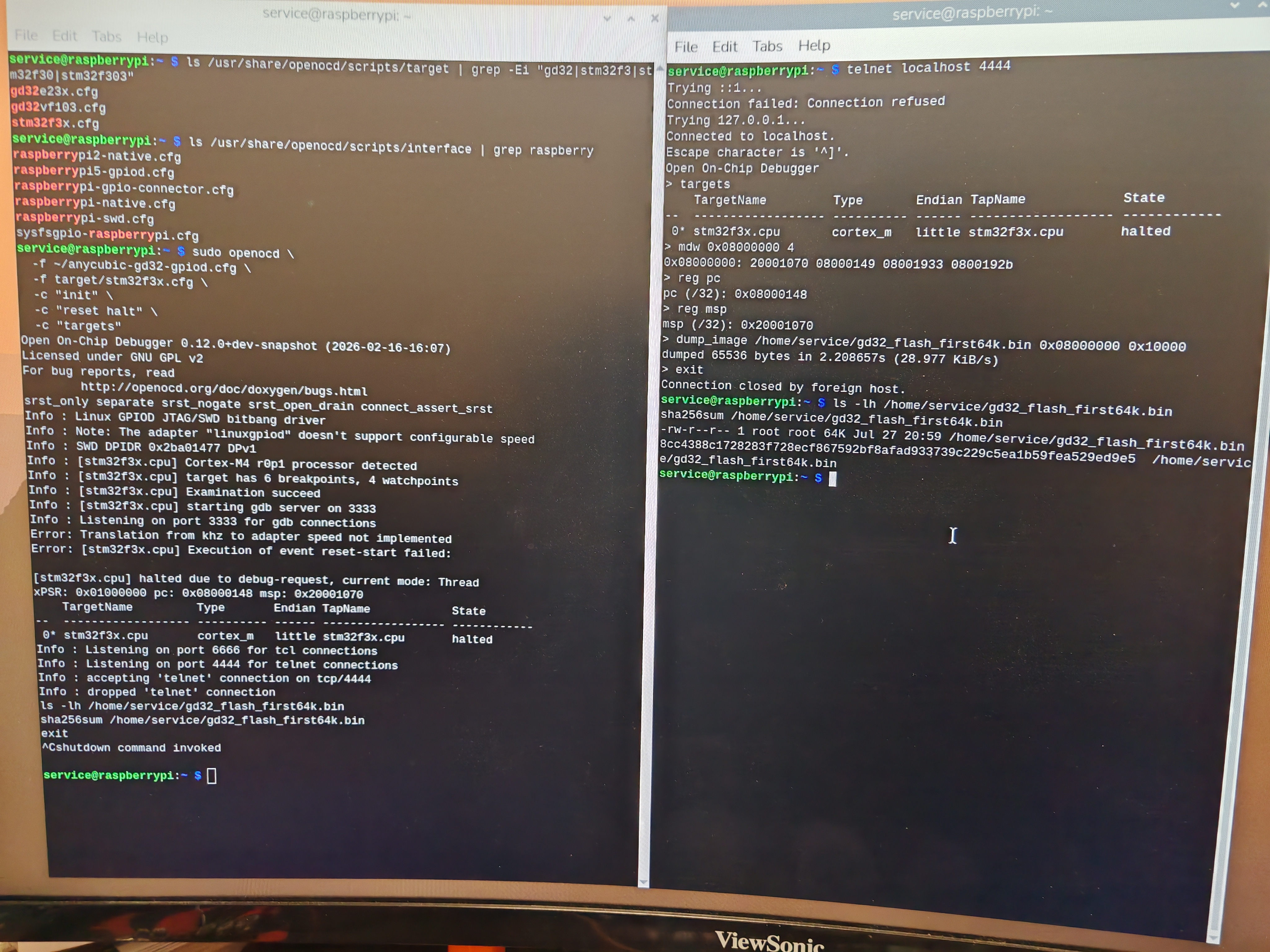
Anycubic Kobra 3 toolhead – successful firmware backup and the first steps toward a CAN-based Klipper toolboard
New printers
1 562

Anycubic Kobra 3 toolhead – successful firmware backup and the first steps toward a CAN-based Klipper toolboard

Anycubic Kobra 3 Toolhead Project – Another Milestone: Successful Firmware Backup and Preparing for a CAN-Based Toolboard Today marked another major milestone in the Anycubic Kobra 3 Toolhead project. Our objective is not to modify or preserve the original firmware. Instead, we are developing a completely custom firmware that will transform the factory controller board into a Klipper-compatible CAN Tool MCU with only minimal hardware modifications.

2026. 07. 27.
Read