LightMake L4: four heads driven by linear motors
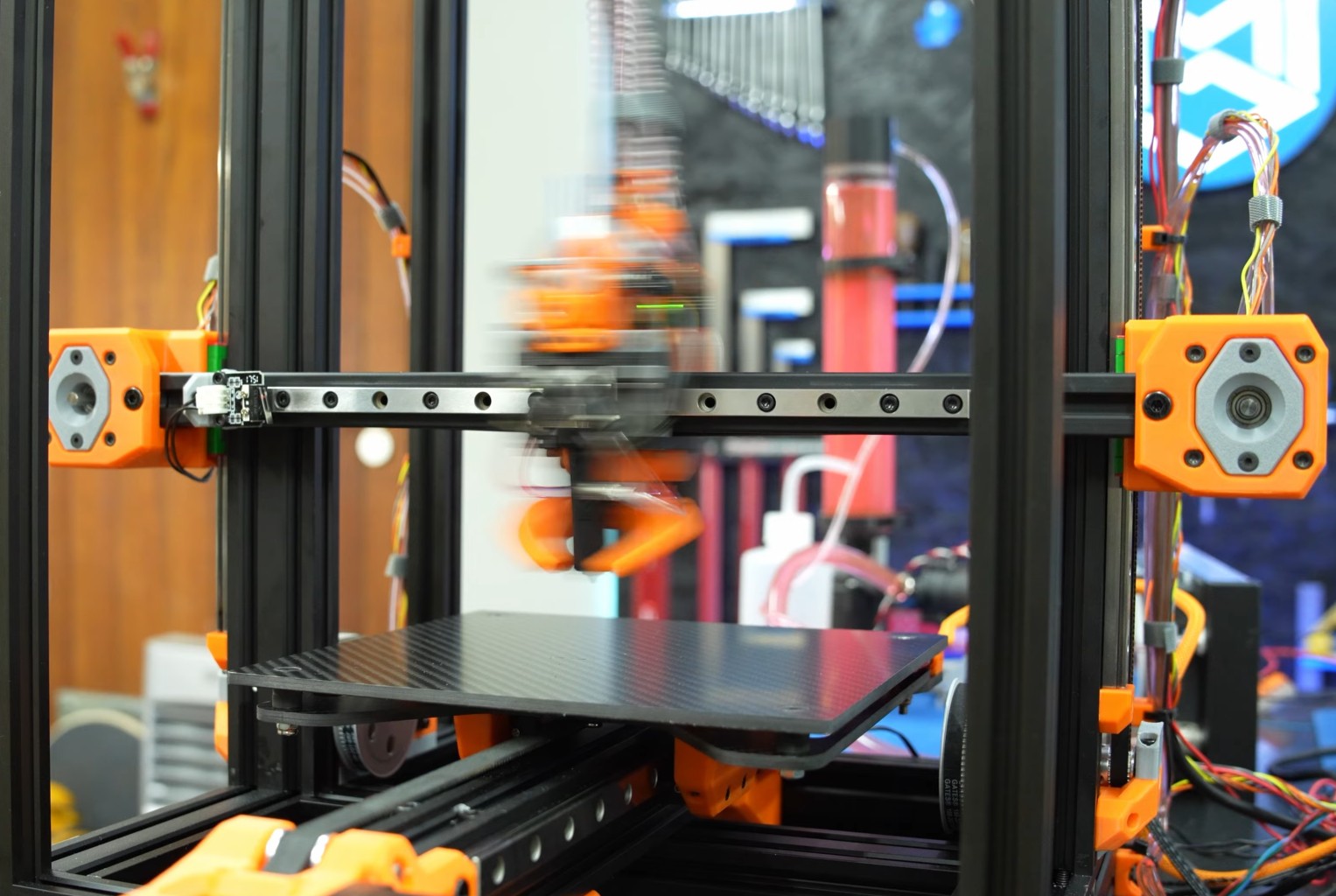
Frankfurt visitors saw four independent heads and a belt-free motion platform. The manufacturer claims one-second tool changes.
Frankfurt visitors saw four independent heads and a belt-free motion platform. The manufacturer claims one-second tool changes.
Engineering implications
Direct electromagnetic drive may reduce belt maintenance. Parallel production depends on usable part dimensions and collision-free head motion. Long-term accuracy still needs production testing.
Launch context and engineering details
A linear motor produces motion directly, eliminating belt elasticity from the drive. The claimed one-second change refers to the mechanical transition rather than the entire sliced cycle. On November 19 the company reported 1,560 backers and more than $2.98 million pledged. The standard nozzle is 0.4 mm, with 0.2, 0.6 and 0.8 mm alternatives.
Practical applications
Cable routing, position feedback and relative calibration of four nozzles deserve more attention than headline travel speed.
Video demonstration

Linear motion and batch production
Alongside the L4, LightMake demonstrated its linear-motor stage and R1 part-removal system in Frankfurt. Its November 19 crowdfunding figures exceeded US$2.98 million. The approach combines belt-free motion, four heads and the prospect of automating the production cycle; a trade-show demonstration does not establish months of production uptime. (Sources: LightMake)


3DPS engineering analysis
Linear motion shifts attention from belt tension to position feedback, cable routing, control-loop tuning and thermal management. Frame stiffness still matters during rapid reversals. An acceptance print with hundreds of changes can reveal first-line continuity, color registration, cycle duration and scrap rate. The nominal one-second change is only part of the complete operation; reheating, pressure recovery and cleaning may add time. For small-batch production, repeating the same geometry without intervention is a better investment indicator than one impressive sample. Module replacement time, spare-part availability and maintenance access should also be evaluated.
Sources
- LightMake – LightMake at Formnext 2026