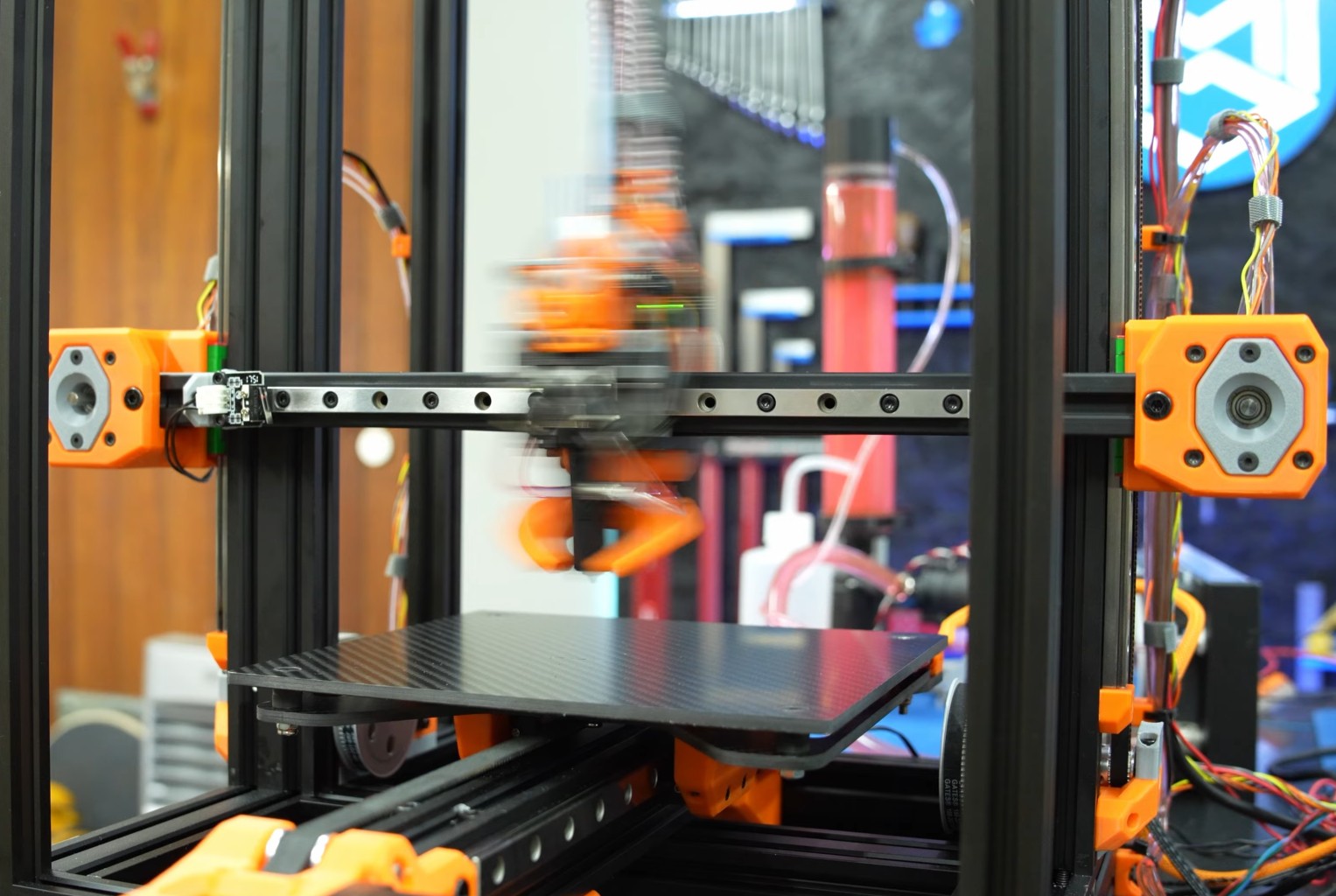
Ender Rhino: a heavily rebuilt Ender 3 prints a Benchy in 2 minutes 17 seconds
Marcel Genis turned a broken Creality Ender 3 into a high-speed test platform featuring carbon-fibre components, all-wheel-drive motion axes, 60 V electronics and a water-cooled hotend. The Ender Rhino managed a 2:17 Benchy, but the creator has not yet beaten the time he set out to challenge.
From broken Ender 3 to Ender Rhino
In a video released on November 20, 2026, maker Marcel Genis rebuilds a damaged, incomplete Creality Ender 3 as a purpose-built speed machine. The project is not a simple slicer tune-up: virtually every key motion, electronics and extrusion subsystem is redesigned. The result is called the Ender Rhino.
One noteworthy engineering choice is to bolt the printer to a workbench weighing more than 200 kg. At extreme accelerations, frame dynamics and reaction forces matter as much as stepper specifications.
Carbon fibre structure and all-wheel-drive axes
The Y axis uses two MGN12 linear rails, FEA-optimised carbon-fibre components and a 9 mm belt-based all-wheel-drive system powered by LDO Kraken motors. The X axis also rides on dual MGN12 rails, but uses a 6 mm AWD belt setup with StepperOnline OMC2504 motors. The Z axis is converted to a belt-driven arrangement.
Custom carbon-fibre plates and SLM 3D-printed aluminium brackets help reduce moving mass. The rebuilt Y gantry weighs less than 1.4 kg, while the toolhead was measured at 331 g before final assembly. These are custom engineering components rather than stock Ender 3 upgrades.
60 V motion control, water cooling and extrusion
A Raspberry Pi 5 runs Klipper alongside a BIGTREETECH Kraken controller with TMC2160 drivers and a 60 V motion power supply. The film also documents the challenges of configuring CAN toolhead electronics and optimising motor performance.
For extrusion, Genis chooses a 100 W water-cooled Goliath hotend, paired with BIQU CPAP-based part cooling and a custom duct. The video reports about 50 mm³/s with a 0.4 mm nozzle and around 64.5 mm³/s after switching to a Bondtech CHT nozzle. Under the stated line geometry, that latter volumetric flow corresponds to approximately 516 mm/s of extrusion-limited print speed. The motors are water-cooled too.
A 1,800 mm/s motion test is not a 1,800 mm/s print
Using Andrew Ellis speed tests, the creator reports a step-loss-free motion test at 1,800 mm/s and 300,000 mm/s². These are motion-test figures, not demonstrated Benchy print speeds. During real printing, volumetric flow, part cooling, corners and the acceleration limit all constrain the achievable result.
A 2:17 Benchy – impressive, but not the targeted record
The Speed Benchy runs use 0.25 mm layers, 0.5 mm line width and 10% infill. Genis progresses through a 2-minute-50-second Benchy to a fastest attempt of 2 minutes 17 seconds. The creator notes that the faster print does not look especially good, and that skipped steps become a problem at roughly 220,000 mm/s² in actual printing.
His stated benchmark was a 1-minute-50-second Ender 3 Benchy. The 2:17 result is therefore 27 seconds short of that target, not a new record. Further upgrades are planned. The real story is the interaction between a powerful motion system, material throughput, cooling and print quality.
Watch the complete build
Watch the nearly 27-minute video: The Quest to Build the FASTEST Ender 3 Ever! – YouTube. The description also credits the suppliers and links to components used in the build.
Explore more of Marcel Genis’s work
The Ender Rhino is part of a wider collection of engineering projects. The maker shares videos, publicly accessible designs and community updates through his own channels. Readers interested in the build can find more work and support the creator directly here:
- YouTube – Marcel Genis channel and future builds
- Thingiverse – files shared for the Ender Rhino build
- Thingiverse – more designs by Marcel Genis
- Patreon – support the creator directly
- Reddit – posts and maker-community discussions
A manufacturing-oriented project page for the custom Goliath water-cooled toolhead is available through PCBWay. The video includes a sponsor and some affiliate links; this article is an independent editorial overview, not a sales listing.
3DPS perspective
Ender Rhino demonstrates how far an ageing, affordable printer platform can be taken through careful mechanical redesign. It is nevertheless a highly specialised, expensive-to-replicate experiment involving custom-machined parts, water cooling, 60 V motor power and substantial firmware tuning. Racing for a Benchy record is a different objective from delivering reliable everyday production.
Source: Marcel Genis’s November 20, 2026 YouTube video and project links provided by the creator. Performance figures are presented as shown in the video and have not been independently tested by 3DPS.