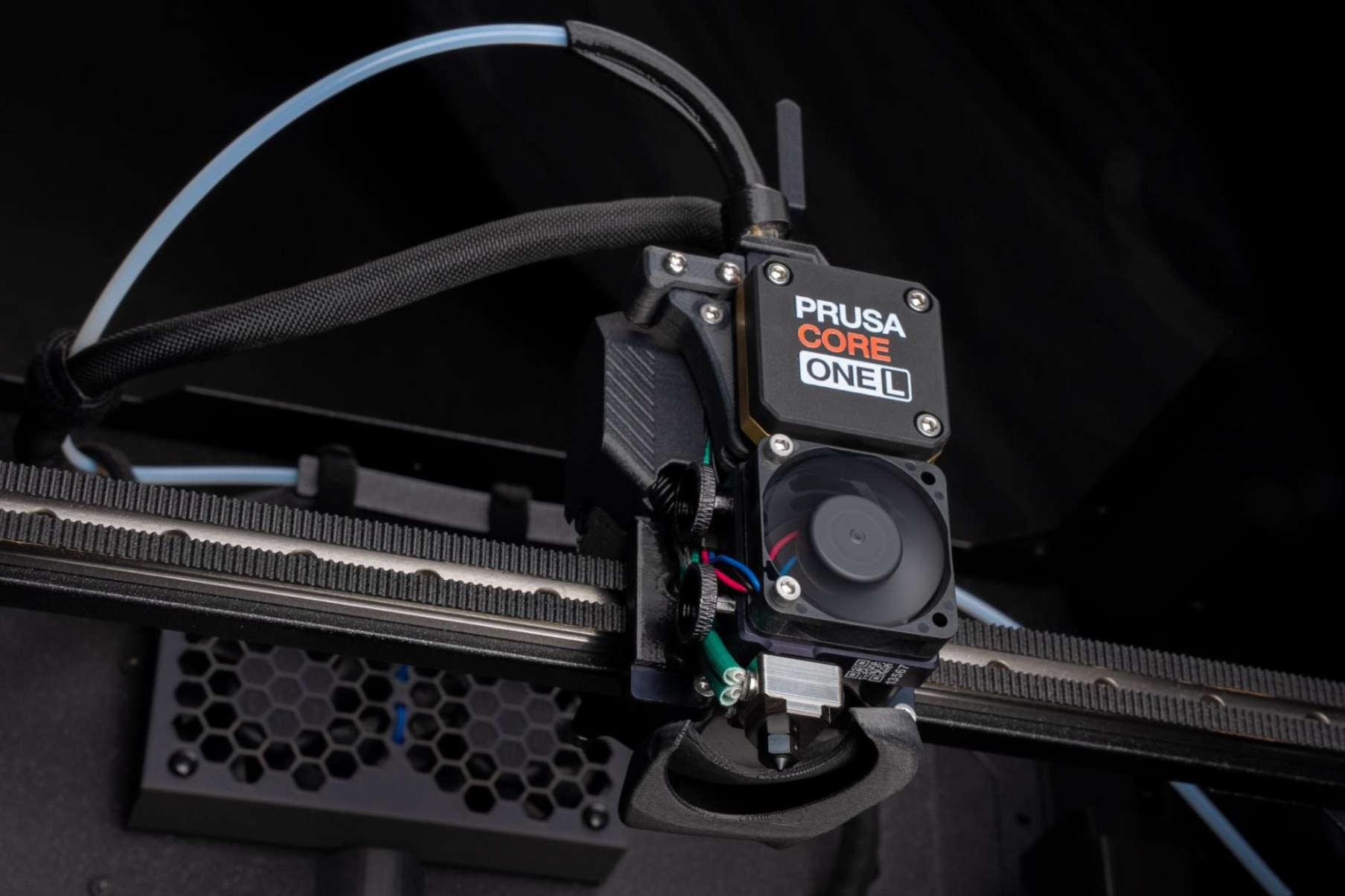
Prusa HT Hotend: 400 °C Printing and New PPS/PPA Filaments
Prusa detailed its 400 °C HT Hotend, HighTemp build sheets and three engineering filaments on October 21. A hotter nozzle alone does not make a desktop printer a PEEK-capable industrial system.
A system, not just a heater
Prusa’s October 21 announcement detailed a quick-change HT Hotend capable of up to 400 °C on supported CORE One printers. HighTemp print sheets and validated material profiles accompany the upgrade, which is available separately or factory-installed in selected configurations.
Three engineering filaments
The new materials include PPS-CF, PPS-GF and PPA-CF Core. Moisture management, bed adhesion, warping and emissions remain as important as the nominal nozzle temperature. A 400 °C heater without an appropriate surface and tuned profile does not guarantee usable engineering parts.
Compatibility and limits
Prusa’s knowledge base lists the CORE One, CORE One+, CORE One+ Gen 2, CORE One L and CORE One L+ with specified compatible nozzles. The HT Hotend does not support MMU or INDX. Because chamber temperatures remain limited, the upgrade should not be confused with a validated high-temperature PEEK or PEI production machine. Prusa also recommends drying hygroscopic materials and using suitable extraction or filtration.