3DPS logo
3DPS Europe
Service and development
News

News / article

Software / AI
← Back to news Back to homepage
UpNano 3DAR Adds Dynamic Three-Axis Voxel Control to 2PP Printing
2026. 10. 14.
214

UpNano 3DAR Adds Dynamic Three-Axis Voxel Control to 2PP Printing

2 min read

UpNano's new 3D Adaptive Resolution technology dynamically adjusts voxel shape and size along all three spatial axes during two-photon polymerization printing, targeting high-quality micro-optics and photonics parts.

UpNano 3DAR Adds Dynamic Three-Axis Voxel Control to 2PP Printing

UpNano 3DAR Adds Dynamic Three-Axis Voxel Control to 2PP Printing

Introduction: UpNano's new 3D Adaptive Resolution technology dynamically adjusts voxel shape and size along all three spatial axes during two-photon polymerization printing, targeting high-quality micro-optics and photonics parts.

Voxel Control Beyond Simply Switching Sizes

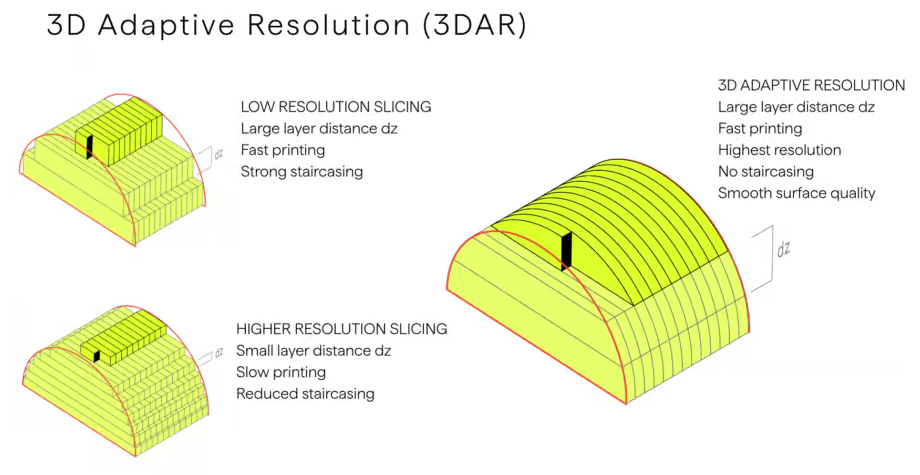
In two-photon polymerization (2PP), a focused laser locally cures a photosensitive material. Voxel dimensions affect both resolution and production speed. UpNano's earlier Adaptive Resolution approach switched between voxel sizes; its new 3DAR system dynamically adapts voxel shape and dimensions along the X, Y and Z axes to match the geometry.

Smoother Surfaces Without Automatically Sacrificing Throughput

Conventional layer-based processes approximate curved surfaces with many stacked layers. Smaller layer heights can reduce stair-stepping, but generally increase print time. 3DAR aims to reduce this trade-off by continuously adapting the voxel itself.

Manufacturer-Reported Results

UpNano reports surface roughness of Sq 3 nm and shape deviations below 20 nm. The company says a 125-micrometre spiral phase plate can be printed in under ten seconds, while a 7-micrometre aspheric microlens takes two to three seconds. These are manufacturer-reported results; broader independent comparisons would be needed to assess practical performance.

Potential Applications

The technology is aimed at micro-optics, photonics packaging and semiconductor applications, where surface geometry directly affects function.


Sources

Related articles
LLNL: AI detects defects during 3D printing
2026. 10. 01.
712

LLNL: AI detects defects during 3D printing

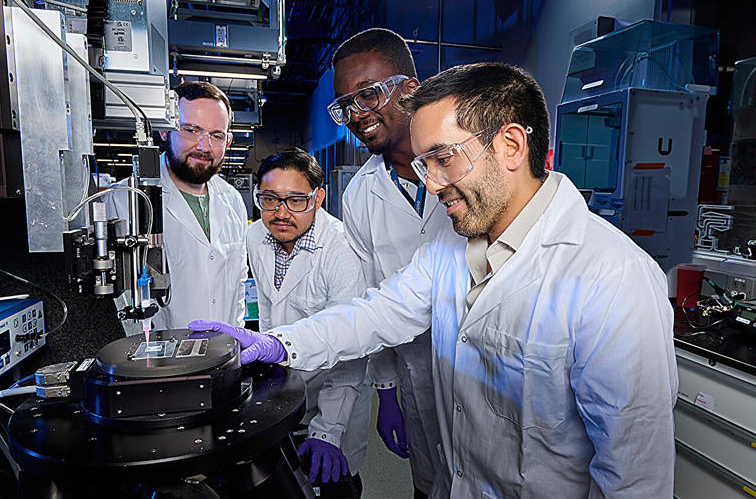
Lawrence Livermore National Laboratory is using camera-based AI inspection to analyze direct ink writing layer by layer and detect defects during the build.

Archive

Earlier news

72 earlier article(s)
CXMT RAM: China Closes the Memory Gap from DDR5 to LPDDR6
2026. 09. 10.
Technology
711

CXMT RAM: China Closes the Memory Gap from DDR5 to LPDDR6

China’s ChangXin Memory Technologies (CXMT) is becoming a serious DRAM competitor: its DDR5 memory is appearing in desktop and server systems, while in September 2026 the company also announced mass production of LPDDR6.

KPI features have been added.
2026. 08. 24.
Technology
562

KPI features have been added.

KPI features have been added. CALIBRA – Measurem Why do KPIs matter in measurement equipment management? Because data becomes truly useful only when it helps you see where attention is needed and how performance changes over time.

CALIBRA – A Free Measurement Equipment Management System Is Under Development
2026. 08. 11.
Technology
506

CALIBRA – A Free Measurement Equipment Management System Is Under Development

CALIBRA – A Free Measurement Equipment Management System Is Under Development A new in-house developed web application is joining the growing collection of 3DPS projects. CALIBRA is being developed as a modern, transparent and expandable measurement equipment and calibration management system. Development has progressed rapidly from the original concept to an already functioning web application, with the foundations of company management, equipment tracking, external partner management and auditing now in place.