QIDI Q3D: Dual Nozzles and Air-Cooled Extrusion Debut at Formnext 2026
QIDI is teasing the Q3D for Formnext 2026, highlighting dual nozzles, air-cooled extrusion and real-time temperature readouts. Full specifications remain under wraps.
QIDI teases a dual-nozzle 3D printer
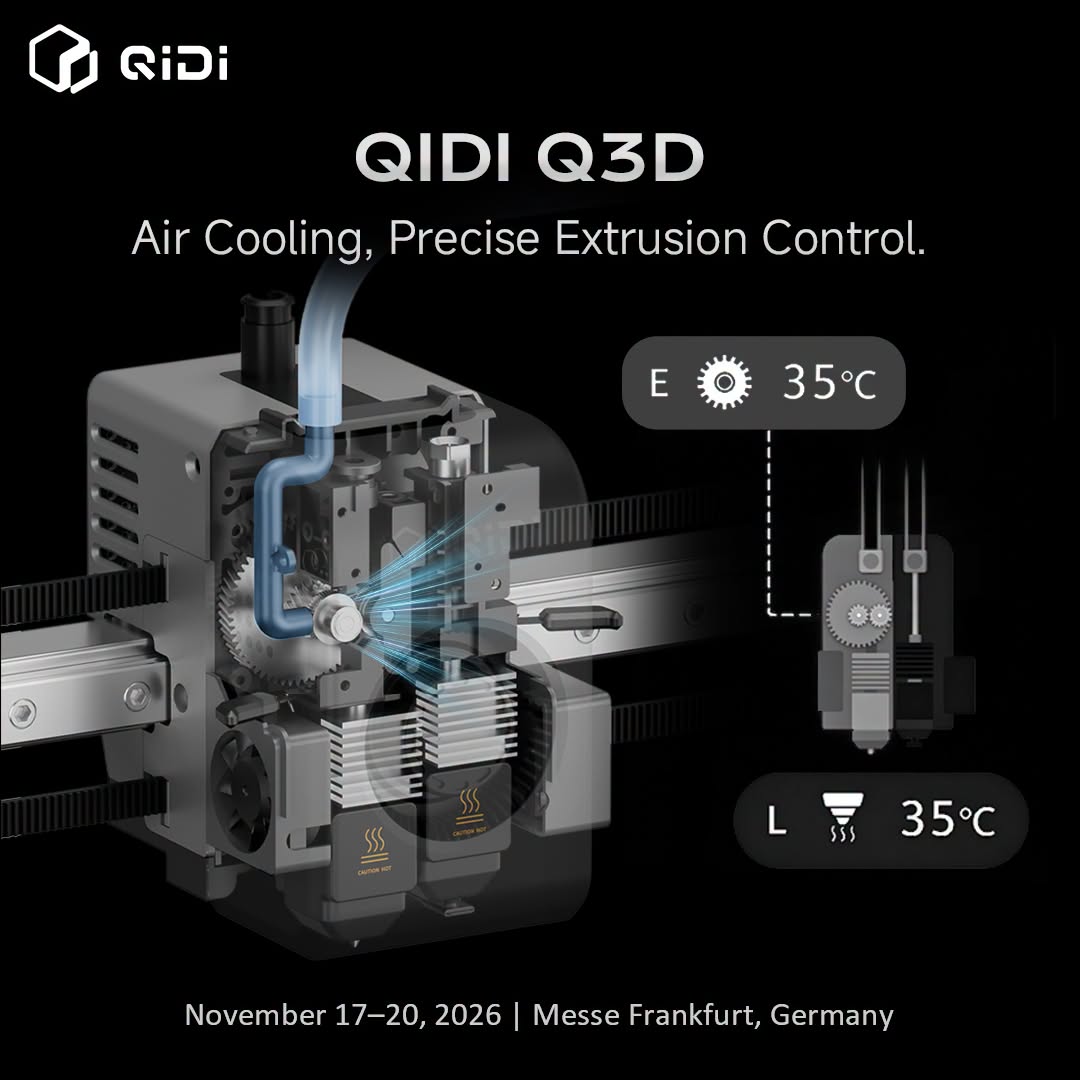
The QIDI Q3D is an upcoming 3D printer that the company is teasing ahead of Formnext 2026 in Frankfurt. An earlier manufacturer post announced a dual-nozzle design aimed at greater printing flexibility. Its latest graphic highlights air cooling for the extrusion system and a real-time temperature display.
Potential advantages of a dual-nozzle architecture include working with two colors or materials, or separating support material from the printed part. However, these are potential use cases rather than verified Q3D features: switching mechanisms, material compatibility and the actual extruder configuration have not been fully disclosed.
Why cool the extrusion system?
In an FDM/FFF printer, the nozzle must be hot enough to melt the polymer, while the filament feed path and the cold side of the hotend need to remain relatively cool. Excess heat creeping upward along the filament path can soften filament before it reaches the intended melt zone. That can lead to inconsistent feeding, jams and clogs — particularly during extended prints or operation in a heated chamber.
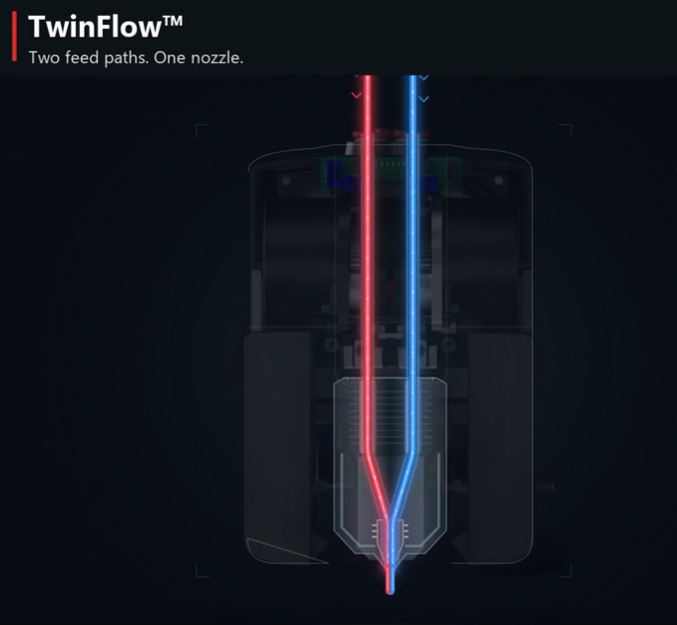
The Q3D teaser uses the words “Air Cooling. Extrusion fully under control. Real-time temperature display.” Its cutaway-style graphic shows an air path aimed at the extrusion system. This is significant because cooling the extruder's cold side is not the same thing as cooling the printed layers.
QIDI already documents a separate Polar Cooler product for cooling the extruder cold side and filament feed path. There is no confirmed information that the Q3D uses that exact unit; its cooling arrangement could differ.
What do the 35 °C labels tell us?
The teaser shows 35 °C twice, alongside the labels “E” and “L”. The company has not clarified the exact sensor locations, measurement conditions, control range or whether those readings represent stable performance under load. We therefore treat them as illustrative displayed readings, not a guaranteed temperature specification.
Real-time visibility into extrusion-system temperatures could be useful for diagnosing heat-related feed problems. However, QIDI has yet to confirm whether these readings will drive automated cooling control, alarms or other protective functions.
Five technical questions for the launch
- Dual nozzles: how are nozzles switched, and are their temperature and material capabilities identical?
- Filament feeding: what is the arrangement of extruders, feed paths and motors?
- Cooling: is the air-cooling solution integrated or external, and how does it perform in a heated chamber?
- Monitoring: where are “E” and “L” measured, and does the temperature display provide closed-loop control?
- Product details: what are the build volume, pricing and availability?
Formnext 2026: where and when
QIDI plans to reveal more about the Q3D at Formnext 2026, November 17–20, at Messe Frankfurt, Hall 12.1, Booth E01. At the time of this preview, the complete official specification sheet and retail pricing had not been published.
3DPS perspective: pairing dual nozzles with more careful extrusion thermal management could be useful for engineering-material workflows. Whether this offers a measurable advantage will depend on testing for temperature stability, clog resistance, material changes, print quality and long-term reliability. A teaser image is not a substitute for technical specifications or independent benchmarks.
Sources: QIDI air-cooling teaser (November 15, 2026); earlier dual-nozzle teaser (November 12); QIDI Polar Cooler documentation; Formnext exhibitor list. The illustration is an unmodified manufacturer graphic supplied for this article.