Fraunhofer Shape Dithering: reducing staircase artifacts without new hardware
Fraunhofer IGD has presented Shape Dithering, a geometry-processing method intended to reduce staircase artifacts in voxel-based 3D printing.
Fraunhofer IGD has presented Shape Dithering, a geometry-processing method intended to reduce staircase artifacts in voxel-based 3D printing.
Where staircase artifacts come from
3D printers represent continuous three-dimensional shapes using layers or voxels with finite resolution. Sloped and curved surfaces can therefore develop visible staircase or quantization artifacts that require post-processing. The effect differs between technologies, but geometry discretization is important in many workflows.
According to Fraunhofer IGD’s November 12 release, Shape Dithering redistributes quantization errors in the digital representation of geometry. The institute describes it as a parameter-free, purely geometric method. That matters because reducing the visible artifact does not necessarily require a redesigned toolhead or new motion mechanics; the intervention takes place in the preparation software.
Not the same as sanding a finished part
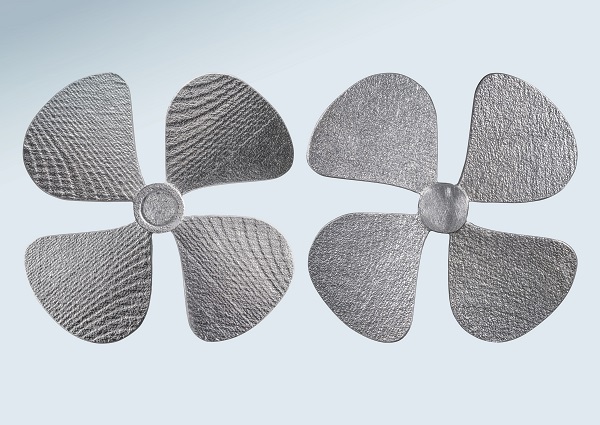
The method acts on the computational shape before printing. Demonstration images compare propeller surfaces and show reduced stair-stepping relative to conventional voxelization. However, they do not prove identical improvements for every machine or material. Dimensional accuracy, strength and manufacturing time still need testing for each process.
At Formnext 2026, Fraunhofer also plans to show unit-cell design and optimization methods as well as RISTRA-AM distortion simulation. The institute says its GPU-based approach can accelerate selected calculations by one or two orders of magnitude compared with established CPU methods.
Why 3DPS is watching
Software-level geometry processing is another path to better part quality without relying solely on expensive mechanics or smaller layers. Next, the underlying measurement methods and compatibility with different manufacturing processes should be examined. Shape Dithering was not presented as a universal one-click FDM slicer feature.
Sources and further information
Original manufacturer source image (Fraunhofer IGD / IGCV): https://www.igd.fraunhofer.de/en/media-center/news-from-the-institute/2026/reducing-staircase-artifacts-in-3d-printing/jcr:content/fixedContent/pressArticleParsys/textwithinlinedimage/imageComponent1/image.img.jpg/1794467514794/FormNext-Shape-dithering-propeller.jpg