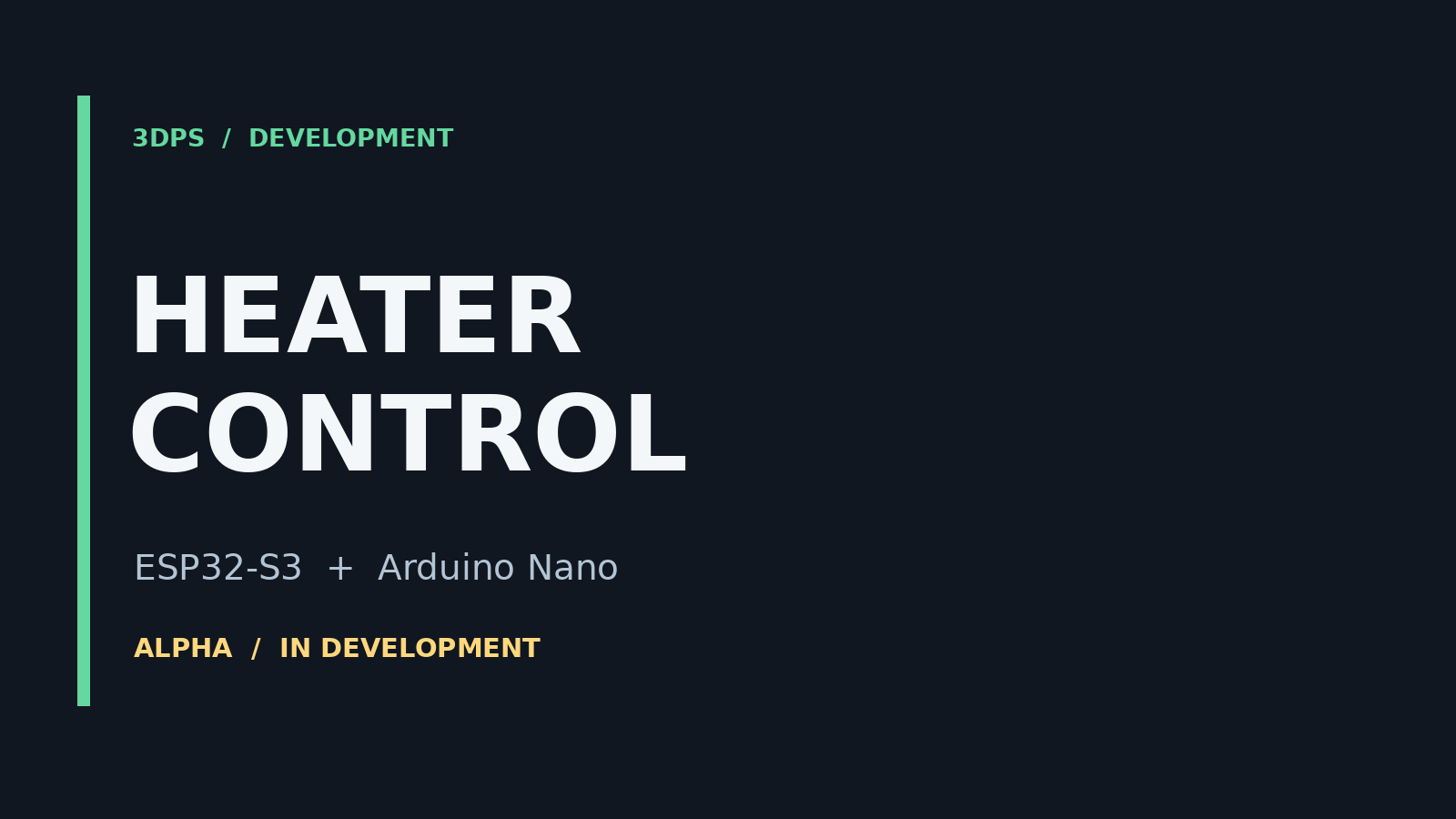
HEATER CONTROL: from temperature monitoring to visually programmable heating control
HEATER CONTROL began with two temperature sensors and a local display. Its development now includes a browser interface and a checked communication link, with configurable hardware assignment and a block-based rule editor forming the next steps.
Built around a real heating system
The project started with a radiator heating system supplied by a wood-burning stove with a water heat exchanger. The initial goal was to display flow and return temperatures, track their difference and provide local feedback when configured limits were exceeded.
An Arduino Nano, two NTC100k sensors, an OLED display, a colour indicator and a buzzer formed the first monitoring system. Displaying ΔT alongside the individual readings provided a clearer picture of the current operating state.
That foundation is developing into a local monitoring and control platform that brings measurements, connected devices and operating rules together in an accessible interface.
Two controllers with separate responsibilities
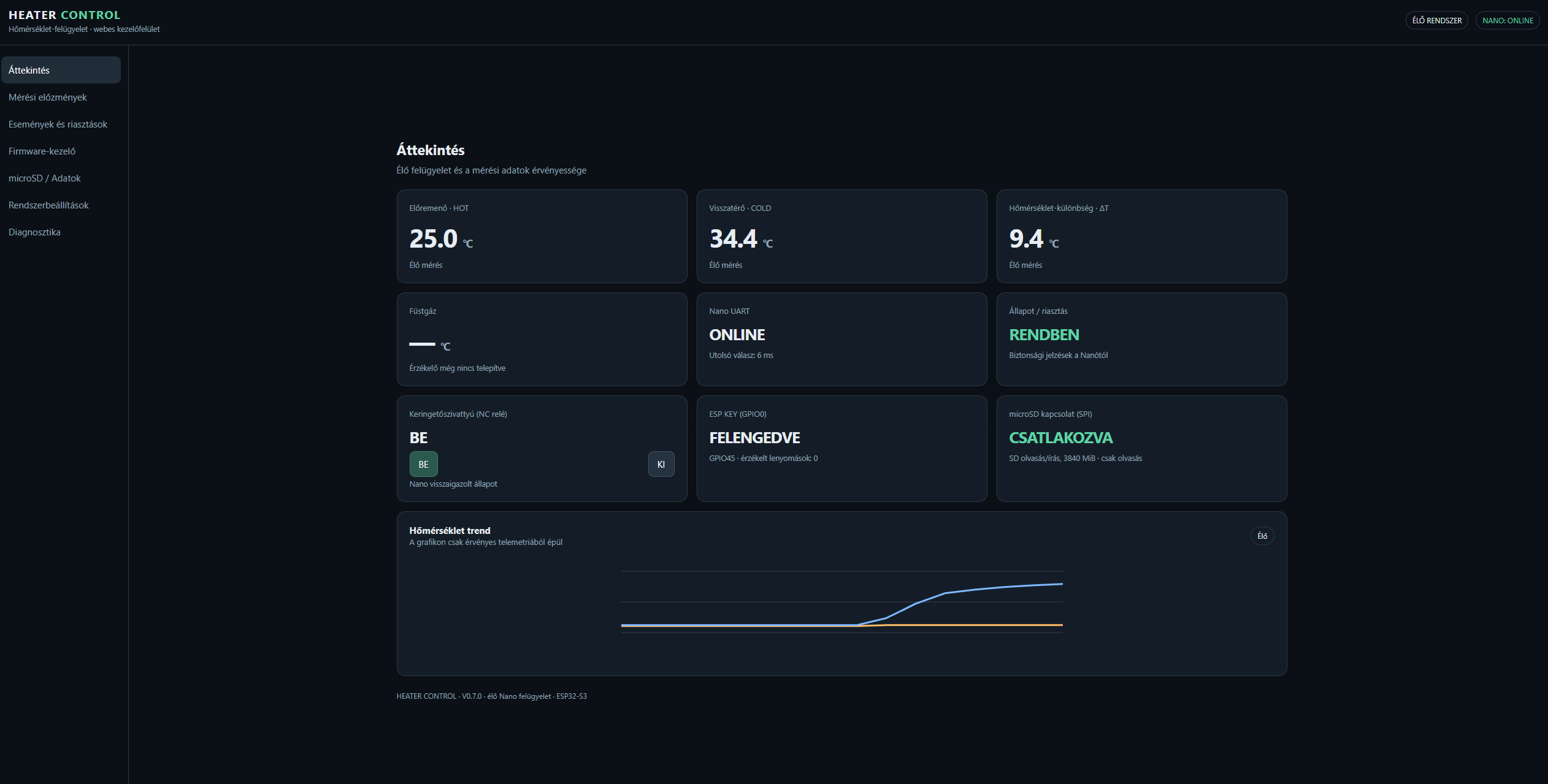
The Arduino Nano provides the basis for local measurement and indication, while the ESP32-S3 supplies Wi-Fi connectivity and the browser interface.
Communication follows a request–response model. The ESP32-S3 initiates an exchange once per second, and the Nano responds to those requests. Sequence numbers and CRC checks help identify corrupted or unexpected replies. Response-time monitoring and timeout handling are also part of the communication foundation.
The purpose is to make the condition of the data link visible alongside the readings, rather than allowing an old measurement to appear current without indication.
A confirmed browser-interface milestone
One recent user-confirmed milestone is the unified V1.0.5 web interface. Its pages share a common layout and consistent navigation.
The overview presents essential readings and a simple Nano connection status. Detailed request–response traffic, timestamps, response times and communication errors belong in a separate diagnostic view.
The development also includes a microSD-based interface and data-management direction. Earlier firmware revisions offered different SD capabilities, so persistent logging and complete file-management availability must be associated with a specific release. Confirmation of the V1.0.5 interface does not amount to full validation of every background feature.
Configurable hardware assignment
The next stage is a hardware manager that makes input and output assignments visible and configurable. The V1.1.0 Hardware Manager development package covers Nano pin presentation, reserved-pin identification and locking, and device assignment.
The aim is to let users work with meaningful devices and signals rather than pin numbers alone. Available modes must follow the actual hardware capabilities: PWM is not available on every pin, and Nano A6/A7 inputs differ from general-purpose digital pins.
Delivery of this development package represents a new stage; its complete on-device operation has not received the same confirmation as the earlier web-interface milestone.
Logic Studio: operating rules built from blocks
The broader goal is a Scratch/Blockly-style editor for constructing rules with IF, THEN and ELSE branches, temperature comparisons, hysteresis, timing and output actions.
A separate Logic Studio browser demo already allows block programs to be assembled and simulated. The concept includes saving, importing and exporting programs, undo and redo, structural checks, step-by-step execution and accelerated simulation. Simulated sensor inputs and outputs help users understand how a rule behaves.
The demo currently has no physical hardware connection. Integrating the visual program with a checked runtime and real devices remains a development task. Example thresholds and simulated fault responses are demonstrations, not operating instructions for a heating installation.
Current development status
HEATER CONTROL has a measurement and communication foundation and has reached a user-confirmed unified-interface milestone. A hardware-manager development package and a separate visual-programming demo extend that foundation.
The next phase focuses on bringing configurable devices, understandable rules and verifiable operation together. HEATER CONTROL remains an ALPHA development project, not a finished production heating controller. It does not replace an installation’s independent safety devices.
HEATER CONTROL – product overview
Product name: HEATER CONTROL
Subtitle: Modular heating monitoring and control platform – in development
Short description: An ESP32-S3 and Arduino Nano platform for monitoring flow and return temperatures, providing local status indications and presenting measurements in a browser. Configurable hardware management and integration of a Blockly-style rule editor are the next development stages.
Full description: HEATER CONTROL grew out of the monitoring needs of a real heating installation. Temperature sensing and local indicators have been complemented by a checked Nano–ESP communication link and a unified browser interface. Its development goal is to reduce the need for custom firmware changes when assigning sensors and actuators or defining operating rules. The visual editor is currently a separate simulation demo. The platform remains in ALPHA development.
| Feature | Current position |
|---|---|
| Platform | ESP32-S3 + Arduino Nano |
| Measurements | Flow temperature, return temperature and ΔT |
| Local indication | OLED, light and sound indications according to hardware revision |
| Communication | UART request–response initiated once per second, with CRC and sequence checks |
| Browser interface | Unified V1.0.5 interface and navigation confirmed by the user |
| Hardware manager | V1.1.0 development package; further validation required |
| Visual programming | Blockly-based simulation demo without a physical hardware connection |
| Availability | In development; price and commercial launch have not been specified |
Call to action: Follow HEATER CONTROL development on the 3DPS website. Contact us to discuss the possibilities for a specific monitoring or control application.
Support HEATER CONTROL development
If you would like to support the continued development of HEATER CONTROL, you can do so through 4fund. Thank you for helping the project move forward!
Support HEATER CONTROL on 4fund
The project is currently in development. This support link is not a purchase or pre-order of a finished product.