Meet InfiMech: The Little-Known Brand Betting on Tool Changing and Automated Build Plates
Six or eight automatically selectable tools, induction heating and automated build plates: meet InfiMech’s TX, EX, MX and MX Pro printers.
Six or eight automatically selectable printing tools, induction-heated nozzles and a separate automated build-plate swapping system. InfiMech may still be unfamiliar in Hungary and much of Europe, but its engineering concepts deserve attention.
Who is InfiMech?
According to its official company profile, InfiMech was founded in 2023 by a team of engineers and PhD-qualified specialists. The company wants users to spend more time designing and manufacturing parts rather than fixing printers.
The brand has Chinese roots, with UK-registered businesses involved in operating its online store. The FlyingBear name is connected to an earlier Kickstarter campaign for automated build-plate changing, though the precise corporate relationship has not been fully explained in the public material.
The product range includes the established TX, the newer EX and the MX and MX Pro tool-changing designs.
MX and MX Pro: Six or eight printing tools in one machine
Most single-nozzle multicolor FDM printers switch materials by retracting one filament, loading another and purging the old material from the nozzle. This process works but consumes time and filament, particularly on prints with frequent color changes.
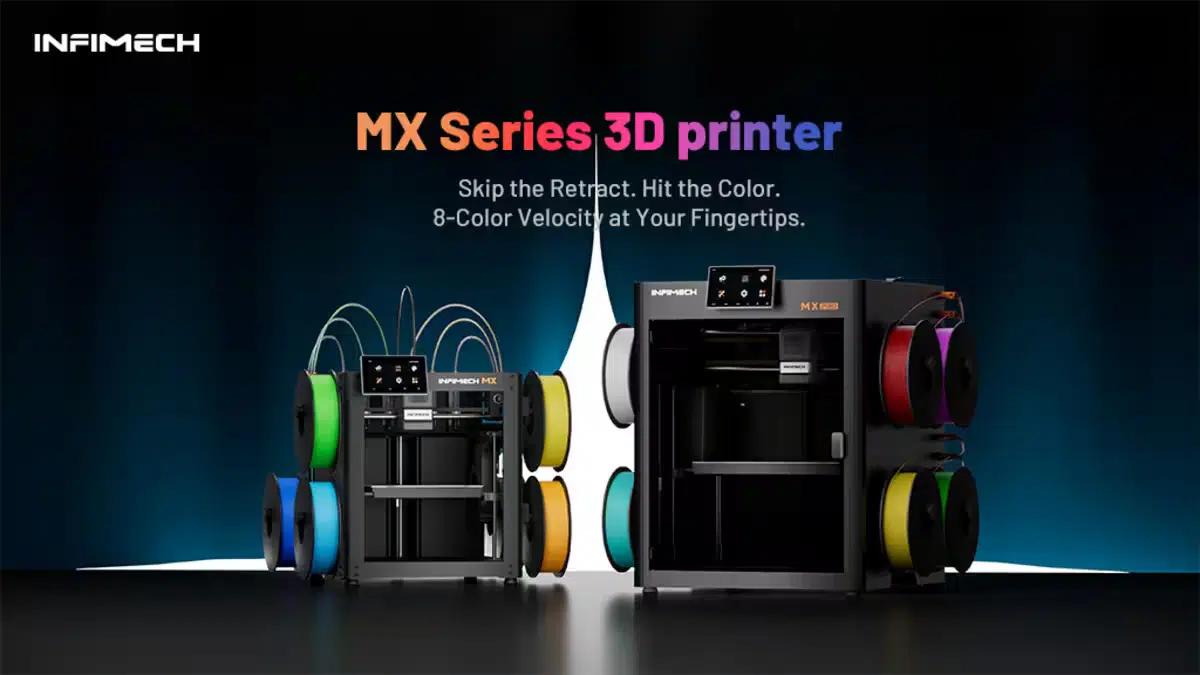
The MX series takes a different approach: each color or material can have a dedicated, prepared printing tool. The machine selects a tool from its parking position. The MX offers six tool positions, while the larger MX Pro accommodates eight.
The engineering behind tool changing
One particularly interesting design element is the proposed induction-heating system. According to the manufacturer, the removable nozzle can be heated without repeatedly mating conventional heater contacts, while wireless feedback supports temperature monitoring.
This could simplify the removable-tool assembly and reduce certain electrical connection failure modes. Precise alignment is just as important: small differences in X/Y/Z offsets between nozzles can cause visible defects. InfiMech therefore advertises adaptive multi-tool offset calibration.
Tool-changing technology itself is not new — the Prusa XL is an established example. What makes InfiMech interesting is the combination of many tool positions, induction heating and ambitious planned pricing.
| Feature | MX | MX Pro |
|---|---|---|
| Tool positions | 6 | 8 |
| Build volume | 220 × 220 × 220 mm | 300 × 300 × 300 mm |
| Frame | Open | Enclosed |
| Induction heating | Planned | Planned |
| Active chamber heating | No | Planned |
| Adaptive calibration | Planned | Planned |
These figures reflect manufacturer announcements and product plans rather than independent performance testing.
Early campaign advertising mentioned conditional VIP prices as low as $249 for the MX and $499 for the MX Pro. These are not established retail prices; eligibility depends on campaign tiers, and taxes, shipping and final European availability require verification.
EX + APS: Automatically changing build plates
While the MX changes printing tools, the APS (Automated Platform System) advertised for the EX targets a different bottleneck: idle time between jobs.
A conventional desktop printer usually waits for an operator after finishing a print. Someone must remove the part, prepare the plate and start the next task. APS is designed to move the completed build plate out of the print area and load another prepared plate, allowing queued work to resume.
An earlier FlyingBear APS campaign showed fresh plates supplied from one side and completed plates collected on the other, promoting seven consecutive plate jobs. However, it is not safe to assume that the Ghost 7 version and the APS offered for InfiMech EX have exactly the same layout or capacity.
Why small workshops might care
For workshops producing fixtures, brackets or repeated small batches, the limiting factor is not always print speed. A finished printer can stand idle for hours until an operator is available to restart production.
Automated plate changing could reduce that downtime and make overnight processing of queued jobs more practical. It does not mean unlimited unattended operation: available plates, filament supply, adhesion, mechanical reliability and failure detection remain important.
What does the EX offer?
- Build volume: 250 × 250 × 205 mm.
- Maximum travel speed: 600 mm/s.
- Maximum acceleration: 20,000 mm/s².
- Nozzle temperature: up to 300°C.
- Bed temperature: up to 110°C.
- Hardened-steel nozzle, quick-release hotend and automatic bed leveling.
- Five-inch touchscreen and support for filament spools weighing up to 3 kg.
- Runout and tangle detection, with power-loss recovery.
The 600 mm/s figure refers to a maximum travel specification, not a guaranteed print speed for every part and filament. An optional upcoming five-color ColorBox accessory is mentioned on the EX product page; the base machine is single-color.
Importantly, the EX quick-release hotend is not the same mechanism as the MX's automatic mid-print tool changer.
Where does the TX fit in?
The TX is an earlier, more conventional high-speed FDM machine with a hardened-steel nozzle. Optional accessories include a camera, auxiliary cooling and filtration. The TX provides useful product-history context, but it does not establish the long-term reliability of the upcoming MX series.
The 3DPS verdict: Two clever answers to two real problems
Tool changing targets material and time lost during multicolor printing. Automated build-plate swapping targets downtime between production jobs.
Both ideas address practical workshop challenges. The MX's induction-heated removable tools and adaptive calibration are particularly interesting mechanically; EX + APS applies a manufacturing-cell perspective to desktop 3D printing.
Independent testing is still essential. How accurately will tool positions be maintained after thousands of changes? How much filament can actually be saved? How reliably will the plate-transfer mechanism work over extended periods? What spare-parts availability, warranties and support will be offered in Europe?
InfiMech is worth watching. Not because it has already proven superior to established competitors, but because it is tackling two genuine problems in additive manufacturing. A future machine combining reliable multiple tools with automatic build-plate handling could become a compelling compact manufacturing cell.
Sources
Data as of October 27, 2026. Specifications and pricing for products still under development may change. The cover is an original, official product photograph.