Musk Has Lost His Marbles… And Now They've Taken Flight!
Elon Musk’s new Roadster drove upside down, briefly took flight and demonstrated extraordinary acceleration. Engineering brilliance—or a boss’s joke turned into an assignment?
There comes a point when being fast, electric and expensive simply isn't enough. Elon Musk apparently thinks the next challenge is making the ground optional.
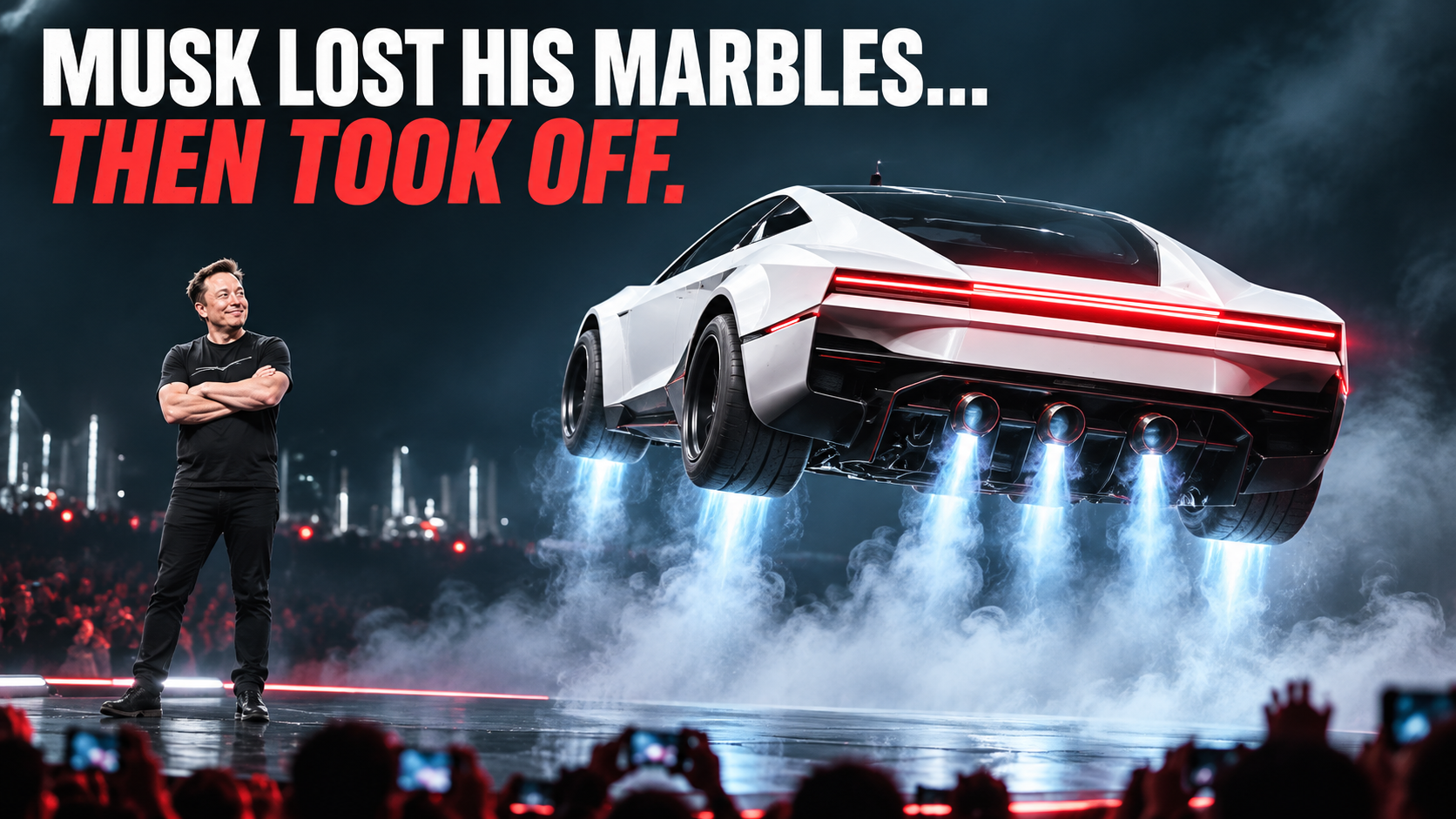
On October 15, 2026, Tesla unveiled a new prototype of its long-awaited next-generation Roadster at a SpaceX test facility in Texas. Calling it a “flying car” is both an exaggeration and, rather surprisingly, not entirely wrong: it really did leave the ground, though not in the way a conventional aircraft does.
Up the wall, upside down, and into the air!
The Roadster drove up a curved ramp, remained attached while inverted, then used gas thrusters to maneuver briefly in the air before landing on its wheels. Another stunt saw it jump over several Tesla vehicles. Two technologies made the show possible: an underbody fan-powered suction system that can generate downforce even at low speeds, and high-pressure gas thrusters developed with SpaceX engineers.
In other words, when four wheels are no longer exciting enough, Musk calls in the rocket engineers. These are cold-gas thrusters, however, not flame-spewing rocket engines.
Zero to 60 mph before you finish the sentence
Tesla reported a 0–60 mph acceleration time of 0.81 seconds during the demonstration. It is a remarkable manufacturer-reported figure, but not an independently verified production-car test.
A flying car? More like an extraordinarily talented jumper
The Roadster briefly left the ground and performed controlled aerial maneuvers. That is not the same as sustained, practical flight. Road legality, safety, everyday usability and whether these features will reach customers remain open questions.
The second-generation Roadster was first announced in 2017. Tesla now targets production in 2028, a timetable best treated as a target given the project's previous delays.
3DPS verdict: complete madness or engineering brilliance?
Both.
The Tesla Roadster demonstration is a perfect example of engineers turning an idea that initially sounds absurd into a working technical demonstration.
But one question remains: how long did Tesla's engineers laugh at the boss's joke before realizing it wasn't a joke at all, but their next assignment?
Cold-gas maneuvering, active downforce, lightweight engineering and the coordination of multiple control systems are fascinating engineering challenges in their own right.
From the 3DPS perspective, the most interesting aspect is the collision of automotive engineering, aerospace technology and rapid prototyping. The demonstration, however, does not establish which manufacturing methods were used for specific parts. We therefore make no unsupported claims about 3D-printed components.
Is this the future of transport, or just the world's most expensive way to jump over a traffic jam?
One thing is certain: this time, it wasn't just Musk's promises that took flight. The Tesla did too.
Watch the demonstration
Videó megnyitása a YouTube-on / Watch on YouTube