UpNano 3DAR Adds Dynamic Three-Axis Voxel Control to 2PP Printing
UpNano's new 3D Adaptive Resolution technology dynamically adjusts voxel shape and size along all three spatial axes during two-photon polymerization printing, targeting high-quality micro-optics and photonics parts.
UpNano 3DAR Adds Dynamic Three-Axis Voxel Control to 2PP Printing
Introduction: UpNano's new 3D Adaptive Resolution technology dynamically adjusts voxel shape and size along all three spatial axes during two-photon polymerization printing, targeting high-quality micro-optics and photonics parts.
Voxel Control Beyond Simply Switching Sizes
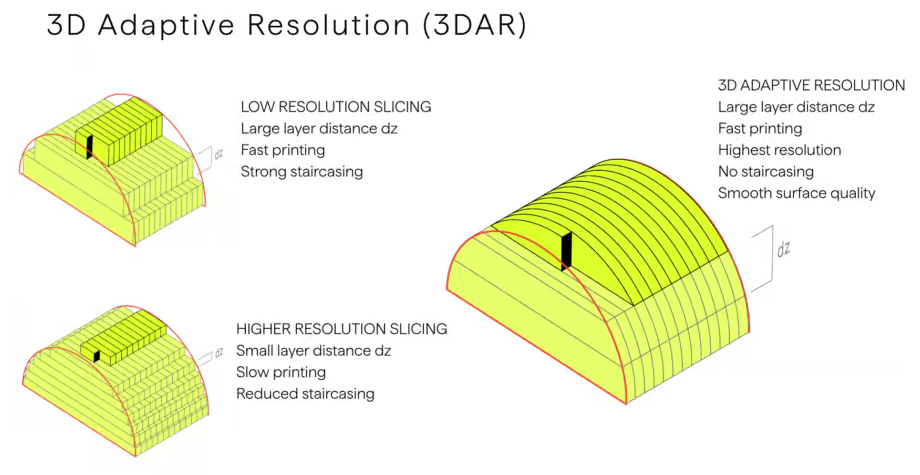
In two-photon polymerization (2PP), a focused laser locally cures a photosensitive material. Voxel dimensions affect both resolution and production speed. UpNano's earlier Adaptive Resolution approach switched between voxel sizes; its new 3DAR system dynamically adapts voxel shape and dimensions along the X, Y and Z axes to match the geometry.
Smoother Surfaces Without Automatically Sacrificing Throughput
Conventional layer-based processes approximate curved surfaces with many stacked layers. Smaller layer heights can reduce stair-stepping, but generally increase print time. 3DAR aims to reduce this trade-off by continuously adapting the voxel itself.
Manufacturer-Reported Results
UpNano reports surface roughness of Sq 3 nm and shape deviations below 20 nm. The company says a 125-micrometre spiral phase plate can be printed in under ten seconds, while a 7-micrometre aspheric microlens takes two to three seconds. These are manufacturer-reported results; broader independent comparisons would be needed to assess practical performance.
Potential Applications
The technology is aimed at micro-optics, photonics packaging and semiconductor applications, where surface geometry directly affects function.